

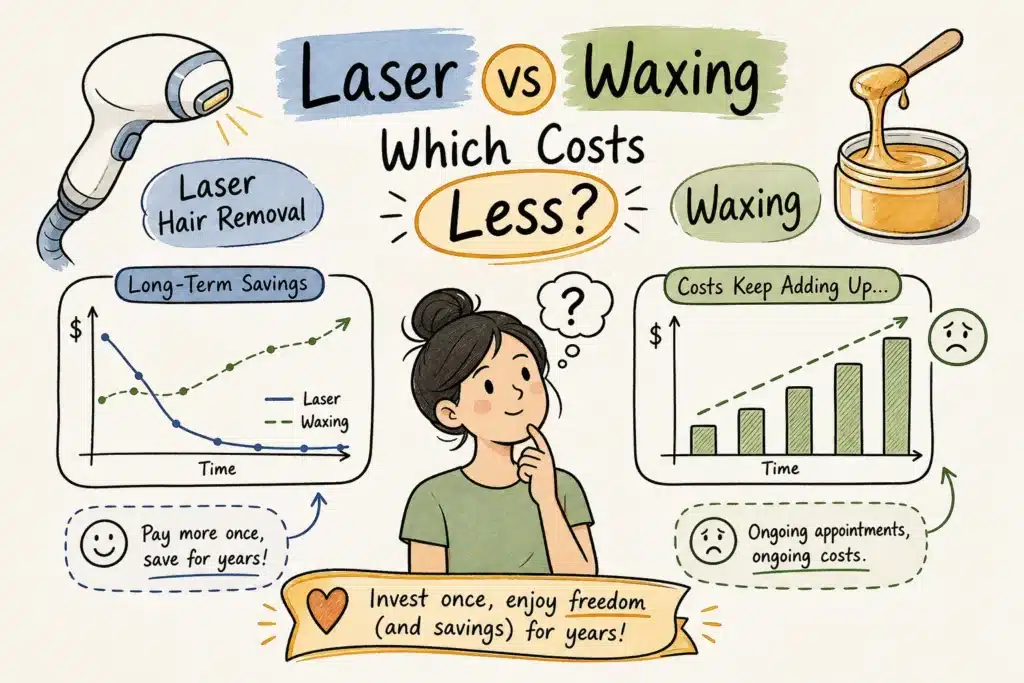
Is laser hair removal worth the cost compared to waxing? For most people, the answer hinges on a number they’ve never actually calculated. A full leg laser course quoted at £900 to £2,000 versus a £30 waxing appointment, that contrast alone stops the conversation. Most people assume waxing is obviously the sensible choice. That assumption costs them thousands of pounds over time.
The real comparison isn’t a single laser course against a single waxing appointment. It’s what you spend across five years of regular bookings versus a one-time course with minimal top-ups. When you run those numbers honestly, the picture changes completely. This article gives you UK price breakdowns, a clear break-even calculation, an honest look at pain and suitability, and a practical checklist to help you decide what makes financial and practical sense for your situation. Pricing examples draw on real figures from clinics including Lazer Lounge, which operates in Derbyshire and Nottinghamshire, so you’re working with genuine market data rather than approximations.
The true lifetime cost of waxing (it adds up faster than you think)
Start with what a single appointment actually costs. In 2026, professional waxing prices across the UK average £8 to £15 for underarms, £22 to £50 for a Brazilian or Hollywood, and £20 to £40 for full legs. These figures are higher in London and the South East, and slightly lower in the Midlands and North. On their own, they look manageable.
The problem is frequency. Intimate areas need waxing every three to four weeks to stay smooth, which typically means 13 to 17 appointments per year. Legs require an appointment every four to six weeks, adding eight to thirteen visits annually. For someone maintaining underarms, bikini, and legs, those numbers stack up quickly, and the annual spend reflects it. Research-backed estimates put professional waxing costs for three common areas at roughly £750 to £1,200 per year, depending on your location and the salon you use.
That figure doesn’t include the hidden costs most people never tally. At-home wax strips and sugar kits for touch-ups between appointments run £8 to £11 per kit. Dedicated ingrown hair treatments like Fur Ingrown Concentrate cost around £28 per bottle, with regular waxers typically going through three to four bottles a year. Add exfoliating products, travel to and from the salon, and time spent across a dozen or more appointments, and you’re realistically adding another £100 to £200 annually without noticing it.
A client waxing underarms, bikini, and half legs spends £700 to £1,100 per year when all costs are included. Over five years, that’s £3,500 to £5,500. Waxing isn’t the cheap option, it’s an indefinite subscription with no exit point.
What laser hair removal actually costs in the UK
Per-session laser prices in the UK currently sit at £50 to £90 for underarms, £60 to £100 for bikini, and £150 to £250 for full legs. Most areas require six to eight sessions for substantial, long-term hair reduction. Hormonal areas like the face or bikini line can need up to 12 sessions, particularly for clients with conditions such as PCOS where elevated androgens continue stimulating new follicles throughout treatment.
Working through the maths for a standard course: underarms come to £300 to £720, bikini to £360 to £800, and full legs to £900 to £2,000. Treat all three and you’re looking at a total course investment of roughly £1,560 to £3,520. That headline figure is what stops people in their tracks, but it isn’t the full picture.
Package pricing makes a significant difference. Most reputable clinics bundle sessions into discounted courses, reducing the per-session cost by £10 to £30. At Lazer Lounge, package pricing comes alongside a free consultation and patch test, so clients receive an accurate quote tailored to their skin and hair type before committing any money. You can walk in, understand exactly what treatment your situation requires, and make a financial decision without any upfront risk.
After the initial course, maintenance is far lighter than most people expect. The majority of clients need one to two touch-up sessions per year, typically at a reduced rate. That ongoing cost is a fraction of what waxing demands every year, indefinitely.
Is laser hair removal worth the cost compared to waxing? The break-even point explained
Here’s where the numbers get concrete. Take three common treatment areas and run a direct comparison. These figures use illustrative package pricing from clinics such as Lazer Lounge; your specific quote may vary depending on the area treated and the clinic you choose.
Break-even by treatment area
| Area | Laser course (package) | Annual waxing cost | Break-even point |
|---|---|---|---|
| Underarms | ~£450, £550 | £130, £195/yr | 2, 3 years |
| Bikini | ~£500, £650 | £264, £600/yr | 18 months, 2 years |
| Half legs | ~£450, £800 (est.) | £180, £260/yr | 2, 3 years |
Combine all three areas and the argument sharpens further. A client treating underarms, bikini, and half legs with laser at Lazer Lounge might invest £1,200 to £1,800 upfront. The same client spending on waxing across those areas pays £574 to £1,055 every single year. By year three, the laser client has spent less in total. By year five, the saving is estimated at between £1,000 and £3,500 depending on the areas treated and the clinic used, a meaningful financial difference that waxing’s low price-per-session structure obscures entirely.
Many UK clinics, including Lazer Lounge, also offer interest-free payment plans spread over three to twelve months, which removes the barrier of the upfront course cost entirely. A package priced at £1,200 becomes £100 per month over a year, less than many clients are already spending on waxing.
Pain, side effects, and downtime: the honest comparison
Laser is most commonly described as a quick snap or warm pinch, typically rated three to five out of ten for discomfort. Waxing involves a sharper, more sustained pulling sensation that most people find more intense. What matters most over the long term is how each changes with time: laser discomfort decreases meaningfully as hair thins across sessions, while waxing pain stays consistent no matter how many years you’ve been going. If you’re already spending money on hair removal, reducing that spend and experiencing less discomfort over time is a straightforward improvement.
Side effect profiles differ too. Laser produces mild redness and swelling that resembles a light sunburn, typically clearing within a few hours to 48 hours. There’s no downtime; clients leave the clinic and carry on with their day. Waxing causes immediate inflammation, occasional bleeding where the skin is delicate, and sensitivity that restricts heat, tight clothing, and sun exposure for several hours afterwards.
Rare risks exist on both sides. Poorly performed laser treatment can cause scarring or hyperpigmentation, which is precisely why choosing a qualified clinic with the right technology matters. Waxing carries its own risks, skin tearing, infection, and persistent ingrown hairs that require ongoing treatment. Neither option is entirely without risk, but laser’s risk profile is well-managed in a professional clinical setting, while waxing risks compound with every repeated appointment.
Does laser work for your skin tone and hair colour?
Laser targets melanin in the hair follicle, which means the contrast between hair pigment and skin tone determines both safety and efficacy. The Fitzpatrick scale classifies skin from Type I (very fair) to Type VI (very deep), and modern diode lasers have expanded the range of skin tones that can be safely treated compared to older technology.
For Fitzpatrick Types I through IV, dark hair responds exceptionally well to laser, with 80 to 90% long-term reduction achievable across most areas. For Types V and VI (deeper skin tones), the Nd:YAG wavelength at 1064 nm is the clinical gold standard because it bypasses surface melanin to target the follicle directly. The Primelase HR diode laser used at Lazer Lounge operates across three wavelengths, 810 nm, 940 nm, and 1060 nm. Clinical data indicates this triple-wavelength system achieved approximately 83% hair reduction in Fitzpatrick IV subjects with no serious adverse effects. For Fitzpatrick V and VI, the Nd:YAG wavelength remains the primary safety benchmark, and a thorough consultation will establish which approach is appropriate for your skin tone.
Laser suitability by hair colour and skin type
Hair colour is the honest limiting factor. Dark hair, black and brown, contains the melanin that laser needs to target effectively. Blonde, red, and white hair contains insufficient melanin for laser to work well, and a reputable clinic will tell you this clearly at consultation rather than take your money for a course unlikely to deliver results. Lazer Lounge’s free patch test and consultation exists for exactly this reason: to establish upfront whether laser is genuinely suitable for your hair type and skin tone, so you’re making an informed decision rather than a hopeful one.
A checklist to help you decide
Before booking anything, run through these questions honestly.
- How much am I currently spending on waxing per year, including products and travel?
- How many areas do I want to treat, and do they combine into a package?
- Is my hair dark enough for laser to be effective?
- Do I have the budget for an upfront course, or would a payment plan help?
- Am I treating a hormonally active area that may need additional sessions?
- Have I confirmed the clinic uses a medical-grade laser system with qualified technicians?
When you speak to a clinic, the questions you ask will tell you a great deal about the quality of their service. Ask what laser technology they use and whether it’s suitable for your specific skin tone. Ask whether technicians are qualified and what their training involves. Confirm whether the package includes a free consultation and patch test, and whether top-up sessions after the initial course are offered at a reduced rate. A clinic that answers these questions directly and without pressure is one worth trusting.
For anyone in Derbyshire or Nottinghamshire, Lazer Lounge’s free consultation is a practical starting point: no commitment, no upfront payment, just a personalised assessment of what treatment would involve, how many sessions your situation requires, and what the total investment looks like.
The financial case, settled
Waxing feels affordable because the cost arrives in small, manageable instalments. Across five years, though, those instalments add up to a figure that dwarfs the cost of a laser course. Asking whether laser hair removal is worth the cost compared to waxing has a clear answer for most people with dark hair treating two or more body areas: laser is the more cost-effective option, not the expensive one.
The exceptions are genuine. Light, red, or white hair doesn’t respond well to laser. Budget constraints that make an upfront course difficult are real, though payment plans address this for most people. Certain skin conditions and hormonal factors affect the number of sessions required and are worth discussing at consultation. The checklist above helps you place yourself accurately on either side of that line.
If the numbers suggest laser makes sense for you, the next step is straightforward. Book a free consultation at Lazer Lounge, get a quote based on your specific situation, complete a patch test, and make your decision with full information. That’s the right way to start a decision that will follow you for years.





