

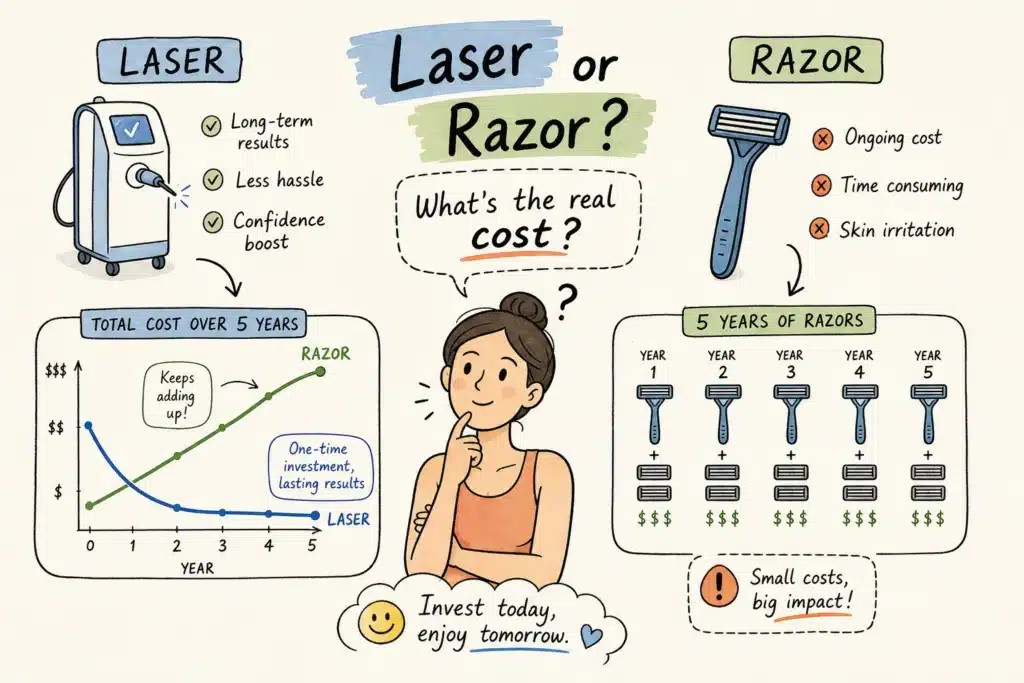
Shaving feels free because the cost is invisible. A few pounds for a fresh pack of razors, a tube of gel that’s nearly empty again, a bottle of serum for those recurring ingrown hairs on your bikini line. None of these purchases feels significant in the moment. But those small, unremarkable expenses repeat every few weeks for decades, and most people have never once stopped to add them up. This laser vs shaving cost comparison uses real UK figures for 2026 to show exactly where the crossover happens and whether making the switch makes financial sense for your situation. This question commonly arises in consultations at our Lazer Lounge clinics in Ripley and Nottingham, and the figures consistently catch people off guard.
The comparison covers more than upfront cost versus ongoing spend. It also accounts for time, skin health, and the point at which laser stops being the expensive option and starts being the financially smarter one. By the end, you’ll have a clear picture of whether switching makes sense for you.
The real annual cost of shaving most people never track
The average person using a premium cartridge razor in the UK spends between £80 and £200 per year on razors and blades alone. Add shaving cream or gel, one tube typically lasts four to six months at around £5 to £10, and the annual total for a regular shaver reaches anywhere from £90 to £220, depending on brand and frequency. Women who shave three to four times per week using disposable razors or mid-range cartridge systems typically spend less, roughly £30 to £80 annually, based on standard product prices and usage patterns. The cost compounds across the years in exactly the same way.
Beyond the basics, regular shavers often spend on products they don’t mentally assign to their hair removal routine. Ingrown hair serums, aftershave balm, hydrocortisone cream for razor burn, and exfoliating scrubs to manage folliculitis may add an estimated £20 to £50 per year to the true total, depending on product choice. Most people don’t count these as shaving expenses, but they exist specifically because of it. Strip those out of your bathroom cabinet and ask yourself how many of them you’d still buy if you never picked up a razor again.
What professional laser hair removal actually costs in the UK
Single-session costs for professional laser hair removal in the UK vary considerably depending on the body area and clinic. Underarms typically sit between £20 and £86 per session; the standard bikini line runs from £35 to £92; facial areas such as the chin or upper lip are typically around £65. Full legs are rarely priced per session in isolation and are almost always bundled into a course. Clinics using advanced systems such as the Primelase HR Diode Laser, which we use at Lazer Lounge, price treatments as part of a full course with free consultations and patch tests included, so there’s no financial commitment before you’ve had a chance to understand exactly what you’re signing up for. For a quick guide to which parts of the body can be treated, see a summary of common treatment areas areas of the body suitable for laser hair removal.
Buying a course of sessions rather than individual appointments cuts the effective per-session cost significantly. A six-session underarm course typically works out considerably cheaper per visit than booking six standalone appointments. Most reputable clinics structure packages around popular treatment combinations such as underarms, bikini line and half legs. Package pricing is where the maths shifts decisively in laser’s favour, and it’s worth asking every clinic you consider for their course rate rather than their single-session price. For a clinic-specific breakdown, our laser hair removal prices list at Lazer Lounge explains how package pricing affects per-session cost.
Most people need six to eight sessions for small-to-medium areas such as underarms, bikini line and upper lip. Larger or hormonally influenced areas, including full legs, back or the Brazilian zone, typically require eight to ten sessions. After the initial course, the majority of clients need only one top-up session per year to maintain results. That annual maintenance cost is a fraction of what continuous shaving costs over the same period. For an independent guide on how many laser hair removal sessions are typically needed, see specialist resources that outline session ranges by area.
Laser vs shaving cost comparison: the break-even point
How we calculated costs
Take one of the most popular treatment combinations at laser clinics: underarms, standard bikini line and half legs. Based on current 2026 market pricing at reputable UK clinics, a six-to-eight-session combined course across these three areas typically costs in the region of £1,200 to £1,600, depending on the clinic and package structure. At a conservative shaving spend of £100 per year covering razors, gel and basic ingrown hair products for the same areas, the laser course approaches break-even within ten to sixteen years. At a more realistic spend of £150 to £180 per year for someone using premium cartridges and supplementary skin products, the break-even point arrives closer to seven to ten years. For general price context from UK clinics, see a consumer-facing guide on how much laser hair removal costs.
That calculation uses only direct product costs. When you factor in the value of time, the crossover moves earlier for many people. After that break-even point, every year spent shaving represents a net financial loss compared to someone who switched to laser. The one-time investment in a laser course, plus a modest annual top-up, outperforms the continuous drip of shaving spend across any ten-year window.
Laser vs shaving cost comparison over 10 years
What a decade of shaving genuinely costs
At £150 per year in shaving products and £30 per year in skin-irritation remedies, a person who shaves regularly spends around £1,800 over ten years. That is a conservative figure. Over twenty years, the total reaches £3,600 or more, and it assumes no significant price increases in razors or consumables, which is unrealistic given the consistent upward trend in personal care product pricing. By contrast, a full laser course for underarms, bikini and half legs at current 2026 package prices, including annual maintenance sessions over the same decade, is likely to total £1,600 to £2,200 depending on the clinic and the number of top-ups required.
The gap narrows, and eventually closes, with time. Someone who makes the switch at 22 versus 35 captures 13 additional years of avoided shaving spend. Even someone switching in their 30s who completes a full laser course and books one annual top-up will, over the following fifteen to twenty years, spend a comparable or lower amount on laser than they would on shaving products alone. The key difference is structure: shaving is a cost that runs for life with no end date, while laser front-loads the investment and then largely removes the ongoing expense.
The costs that never appear on a receipt
A person who shaves for ten minutes per session, three times per week, spends roughly 26 hours per year on hair removal. Over twenty years, that amounts to more than 500 hours, the equivalent of three full working weeks, dedicated to a task that achieves no lasting result. Professional laser hair removal requires 30 to 60 minutes every four to six weeks during an initial course, then one short annual appointment. The total time investment is a fraction of what continuous shaving demands, and results offer long-lasting reduction with only occasional maintenance needed. The time burden of daily or weekly shaving is discussed in consumer pieces that quantify hours lost to routine grooming, and it’s worth considering when you value your time.
Shaving is also a common cause of ingrown hairs, razor burn and folliculitis in the areas people treat most frequently. Managing these side effects costs both money and skin health over time. Professional laser hair removal actively reduces ingrown hairs from the first few sessions, which is one of the most immediate and noticeable quality-of-life improvements clients report. The mild redness that follows a laser session typically resolves within one to two days and is a fixed, predictable inconvenience rather than the chronic, recurring irritation that frequent shaving produces. For clinical perspectives on side-effects and outcomes, see relevant research and reviews.
What to ask before you invest in a laser course
Before committing to a package, ask the clinic for the total cost of the full treatment plan for your chosen areas, not just the per-session rate. Confirm whether the package price includes a free consultation and patch test before you pay anything. Ask about their policy if you need more sessions than the standard number to reach the expected level of reduction. A reputable clinic will provide clear, written pricing without pressure and will offer a patch test as standard before any financial commitment. At Lazer Lounge, both of those things come as part of every consultation.
Technology and technician qualifications matter as much as price. Not all laser systems perform equally across different skin tones and hair types. Ask specifically what laser the clinic uses and whether it is suitable for your Fitzpatrick skin type. The Primelase HR Diode Laser used at Lazer Lounge is reported to be suitable for a wide range of skin tones, confirm suitability for your specific skin type during your consultation, as individual results vary. Confirm also that treatments are carried out by practitioners with recognised training qualifications. A poorly matched laser or an undertrained operator can mean more sessions, lower reduction rates, and a significantly higher total cost in the long run.
The verdict on this laser vs shaving cost comparison
Shaving looks cheap on a weekly basis. It isn’t cheap across a lifetime. The true comparison between shaving and laser hair removal is not a single session against a single purchase: it’s a continuous, indefinite cost against a front-loaded investment with a clear endpoint. At current 2026 UK clinic pricing, the financial case for laser strengthens considerably once you look beyond the first few years, particularly for anyone spending at the higher end of the shaving cost range on premium razors and supplementary skin products. Everything beyond the break-even point is money that stays in your pocket rather than going towards razors, cartridges and serums that achieve nothing permanent. For a broader look at competing hair-removal methods, see our in-depth comparison Laser vs Waxing vs Shaving, Who’s the Real Winner?.
If you want to work out the figures for your specific areas, including an at-home laser vs clinic price comparison or a personalised breakdown, Lazer Lounge offers free consultations at our clinics in Ripley, Derbyshire and Nottingham. Bring your questions, and we’ll give you a personalised quote alongside an honest breakdown of the sessions you’re likely to need. For full details on our local fees and offers, see Prices, Laser Hair Removal, at Lazer Lounge, Derby. The figures tell a clear story once you see them side by side.





