
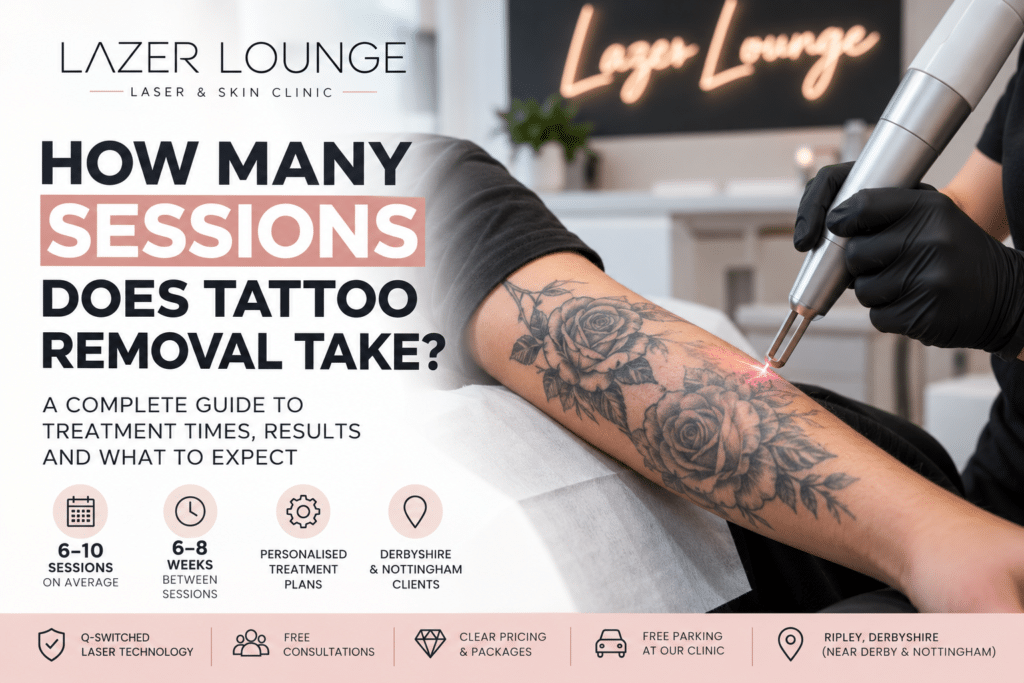
Thinking about removing an unwanted tattoo but wondering how many treatments you’ll need? You’re certainly not alone. One of the most common questions people ask before booking laser tattoo removal is: How many sessions does tattoo removal take?
Whether you have a small black tattoo, a large colourful design or an old tattoo you’d rather forget, understanding the treatment process can help you make an informed decision.
At Lazer Lounge, our laser and skin clinic in Ripley, Derbyshire, we offer professional laser tattoo removal for clients travelling from Derby, Nottingham, Alfreton, Mansfield and surrounding areas.
In this guide, we’ll explain how many laser tattoo removal sessions you might need, what affects your results, how long the process takes and what to expect during treatment.
How Many Sessions Does Laser Tattoo Removal Usually Take?
Most tattoos require approximately 6–10 laser tattoo removal sessions, although some may need fewer treatments and others considerably more.
There isn’t a fixed number that works for everyone. Every tattoo is different, and the number of sessions required depends on several factors, including its size, colour, age, ink density and location.
For example, a small black tattoo with relatively light shading may respond differently from a large, professionally applied tattoo containing several colours.
At Lazer Lounge, we use Q-switched laser technology to target tattoo pigment and gradually fade unwanted ink.
During your consultation, we’ll assess your tattoo and discuss a realistic treatment plan based on its individual characteristics.
It’s important to understand that complete tattoo removal cannot always be guaranteed. Some tattoos may leave residual pigment, changes in skin colour or a faint outline even after several treatments.
Laser Tattoo Removal Derbyshire
What Affects the Number of Tattoo Removal Sessions?
Several factors influence how quickly a tattoo fades. Understanding these can help explain why one person might achieve significant fading after a few treatments while another requires a longer course.
1. Tattoo Size and Ink Density
The size of your tattoo is an important consideration, but it isn’t the only factor.
A small tattoo containing heavily packed black ink can sometimes require more sessions than a larger design with light shading.
Professional tattoos often contain greater concentrations of ink placed consistently into the skin. Amateur tattoos may have less pigment, although their depth can be unpredictable.
Large tattoos may also require longer appointments or treatment in sections, depending on their size and location.
2. Black Ink vs Coloured Tattoos
Tattoo colour can make a significant difference to the removal process.
Black ink generally responds well to appropriate laser wavelengths because it absorbs a broad range of light.
Coloured tattoos can be more challenging because different pigments absorb different wavelengths.
At Lazer Lounge, we assess tattoos containing black, red, blue and green ink to determine whether they are suitable for our Q-switched laser system.
Some colours may respond more slowly, and certain pigments may not be removable with the wavelengths available.
If your tattoo contains several colours, your treatment plan may need to account for each pigment separately.
3. How Old Is Your Tattoo?
You might be surprised to learn that older tattoos can sometimes be easier to fade than newer ones.
Over time, some tattoo pigment may gradually break down or become less concentrated.
However, tattoo age alone doesn’t determine how many sessions you’ll need.
A heavily saturated tattoo that’s 15 years old may still require more treatments than a lightly shaded tattoo applied more recently.
The quality, depth and composition of the ink remain important factors.
4. Tattoo Location on Your Body
Where your tattoo is located can also affect how it responds to treatment.
The body’s immune system plays an essential role in clearing fragmented tattoo pigment.
Tattoos on areas with better circulation may sometimes respond more efficiently than those on the hands, feet or lower legs.
However, individual responses vary, and location is only one part of the overall assessment.
5. Your Skin Type and Healing Response
Your natural skin tone, medical history and healing response must be considered before treatment.
Darker skin tones can require additional precautions because the laser may also interact with natural skin pigment.
A practitioner should select suitable settings and explain the potential risks, including pigmentation changes.
Previous scarring, certain medications and underlying skin conditions can also influence whether treatment is appropriate.
At Lazer Lounge, we offer consultations and patch testing to assess suitability before beginning a treatment course.
Tattoo Removal Results After 1, 3, 6 and 10 Sessions
One of the biggest misconceptions about laser tattoo removal is that the tattoo should disappear immediately after treatment.
In reality, tattoo fading is a gradual process.
After Your First Tattoo Removal Session
During your first treatment, laser energy targets pigment within the skin.
The laser breaks some of the ink into smaller particles, which your body’s immune system gradually processes.
Immediately afterwards, the tattoo may appear temporarily white or frosted. This reaction is not the same as permanent fading.
You may also experience redness, swelling or sensitivity.
Some people notice visible fading over the following weeks, while others see relatively little change after their first appointment.
After Three Tattoo Removal Sessions
By the third session, some tattoos show noticeable lightening.
Black lines may appear less defined, shaded areas may begin to fade, and sections of the tattoo may respond at different rates.
However, not everyone experiences the same progress.
Dense professional tattoos, certain colours and tattoos on particular body areas may require considerably more treatment before obvious fading develops.
After Six Tattoo Removal Sessions
For some tattoos, six sessions can produce substantial fading.
You might notice that darker sections have become lighter or that parts of the design are less visible.
If you’re planning a tattoo cover-up, this level of fading may sometimes be sufficient for your tattoo artist to work with.
However, six sessions should not be viewed as a guarantee of complete removal.
After Ten Tattoo Removal Sessions
Some tattoos may be significantly faded after ten sessions, while others still contain visible pigment.
Stubborn colours, deeply embedded ink and heavily saturated designs may need additional treatment.
There may also come a point where further laser sessions provide limited improvement.
A responsible practitioner should review your progress regularly and discuss whether continuing treatment is worthwhile.
Remember: Tattoo removal before-and-after photographs can be useful, but they should never be treated as a guarantee of your own results.
Tattoo Removal Before and After Results
How Long Should You Wait Between Tattoo Removal Sessions?
Laser tattoo removal appointments are commonly spaced approximately 6–8 weeks apart, although longer intervals may be appropriate.
At Lazer Lounge, treatment intervals are discussed individually, taking account of your skin’s recovery and the response to previous sessions.
Why is waiting important?
Firstly, your skin needs time to heal after laser treatment.
Secondly, your immune system continues processing fragmented tattoo pigment during the weeks following an appointment.
Booking treatments too close together doesn’t necessarily produce faster results and may increase the risk of complications.
How Long Does a Full Tattoo Removal Course Take?
If your tattoo requires eight sessions spaced eight weeks apart, there are seven intervals between the first and eighth appointments.
That represents approximately 56 weeks from your first treatment to your eighth, before allowing for further fading and healing.
Some courses take less time, while others can extend beyond a year or even two years.
It’s sensible to view tattoo removal as a longer-term process rather than a quick cosmetic treatment.
How Does Q-Switched Laser Tattoo Removal Work?
At Lazer Lounge in Ripley, Derbyshire, we use Q-switched laser technology for tattoo removal.
A Q-switched laser delivers extremely short pulses of concentrated light energy into the skin.
Tattoo pigment absorbs suitable wavelengths of light, causing some ink particles to fragment.
Your body’s immune system then gradually helps clear these smaller particles over time.
This process is repeated over multiple appointments until the desired level of fading is achieved or further treatment is no longer appropriate.
Is Q-Switched Tattoo Removal Effective?
Q-switched lasers are an established technology used in professional tattoo removal.
They can be effective for suitable tattoos, particularly certain dark pigments.
However, treatment effectiveness depends on the wavelengths available, tattoo characteristics, laser settings and practitioner expertise.
No single laser system can guarantee removal of every tattoo colour.
During your consultation, we’ll explain whether your tattoo is suitable for the technology available at Lazer Lounge.
Can You Remove a Tattoo in Just One Session?
For conventional laser tattoo removal, complete removal in one session is generally unlikely.
Tattoo ink is deposited within the skin, often in multiple layers, and attempting to remove everything in one treatment can increase the risk of injury.
You may have heard about multi-pass techniques such as R20 tattoo removal, where several laser passes are performed during one appointment.
Although these techniques have been studied, they don’t guarantee complete removal in a single visit and can involve additional skin injury.
At Lazer Lounge, suitability for any particular treatment technique must be assessed individually.
The safest approach is to prioritise appropriate treatment, healing and realistic expectations rather than rushing the process.
How Many Sessions Are Needed to Fade a Tattoo for a Cover-Up?
Not everyone wants their tattoo removed completely.
Sometimes, the aim is simply to fade an existing tattoo enough for a new design to be placed over it.
This is known as tattoo removal for a cover-up.
Because the goal is partial fading rather than complete clearance, fewer sessions may be needed.
At Lazer Lounge, we commonly discuss an initial estimate of around four sessions for cover-up fading, although some tattoos may require fewer or more.
The amount of fading needed depends on the existing tattoo’s darkness, size, colours and the design you want to replace it with.
For example, a large dark tattoo may need significant lightening before a detailed new design can be applied successfully.
We recommend discussing your plans with your tattoo artist so you both understand the level of fading required.
Laser Tattoo Removal for Cover-Ups
How Much Does Laser Tattoo Removal Cost in Derbyshire?
The total cost of tattoo removal depends on the size of your tattoo, the number of sessions needed and the treatment approach.
At Lazer Lounge, advertised standard tattoo removal prices currently start from £40 per session for very small tattoos up to 2cm, with small tattoos up to 5cm starting from £60 per session.
Larger tattoos are assessed individually, and a personalised quotation can be provided during your consultation.
We also advertise six-session and eight-session package options for eligible treatments, which can reduce the cost compared with paying for each appointment separately.
For example, a very small tattoo priced at £40 per individual session would cost £320 across eight pay-as-you-go treatments. An eligible eight-session package is currently advertised at £240.
These examples are illustrative, and prices should always be confirmed before booking.
Because the final number of sessions cannot be guaranteed, your total cost may change if additional treatments are required.
Our aim is to explain the available options clearly so you can make an informed decision.
[INSERT INTERNAL LINK: Tattoo Removal Prices – Main Service Page]
Does Laser Tattoo Removal Hurt?
Laser tattoo removal can be uncomfortable, although everyone experiences the sensation differently.
Many people compare it to an elastic band repeatedly snapping against the skin.
The level of discomfort can depend on the tattoo’s location, size, individual pain tolerance and treatment settings.
Smaller tattoos generally require shorter appointments, which some clients find easier to manage.
Your practitioner can explain the comfort measures available and what to expect before treatment begins.
It’s important not to assume that laser tattoo removal is completely pain-free.
Will Laser Tattoo Removal Leave a Scar?
When performed appropriately, laser tattoo removal can fade unwanted pigment without significant permanent skin damage.
However, scarring is a recognised risk and cannot be ruled out.
Temporary redness, swelling, blistering and crusting may occur. Changes in skin pigmentation or texture are also possible.
Following aftercare instructions and allowing sufficient healing time between sessions can help reduce complications.
You should avoid picking at blisters or scabs, protect healing skin from sunlight and contact your practitioner if you develop concerning symptoms.
If you experience spreading redness, increasing pain, pus or fever, seek medical advice promptly.
Why Choose Lazer Lounge for Tattoo Removal in Derbyshire?
If you’re looking for professional laser tattoo removal near Derby or Nottingham, Lazer Lounge offers a convenient option in Ripley, Derbyshire.
We understand that deciding to remove a tattoo can be personal.
Perhaps you no longer like the design, want to remove an old name or are preparing for a completely new tattoo.
Whatever your reason, our approach focuses on providing clear information and a treatment plan tailored to your tattoo.
At Lazer Lounge, you’ll find:
- Q-switched laser tattoo removal for suitable tattoo pigments.
- Free consultations and patch testing to discuss treatment suitability.
- Personalised treatment planning based on your tattoo and skin.
- Clear pricing and package options to help you plan.
- Free parking outside the clinic, making appointments more convenient.
- A private clinic environment where you can discuss your concerns comfortably.
Our clinic welcomes clients from Ripley, Derby, Alfreton, Belper, Heanor, Eastwood, Nottingham, Mansfield and surrounding Derbyshire and Nottinghamshire areas.
Lazer Lounge Location and Contact Page
Frequently Asked Questions About Tattoo Removal Sessions
How many sessions does it take to remove a small tattoo?
Small tattoos can sometimes require fewer sessions, but size alone doesn’t determine treatment numbers. A small, heavily saturated tattoo may still need numerous appointments.
How many sessions does it take to remove a black tattoo?
Black ink often responds well to suitable laser wavelengths. Many tattoos require approximately 6–10 sessions, but some need more, depending on ink density, depth and other factors.
Can a tattoo be completely removed?
Some tattoos can be removed to the point where little or no visible ink remains. However, complete clearance isn’t guaranteed, and residual pigment or skin changes may remain.
Does tattoo removal work on red, blue and green ink?
These colours may respond to laser treatment, but they can require different wavelengths and may be harder to remove. Suitability depends on the pigments and equipment available.
How soon will I see results after my first session?
Some fading may become visible over the following weeks. Other tattoos respond more gradually, and several sessions may be needed before substantial changes appear.
Is it better to wait longer between tattoo removal sessions?
Sometimes. Longer intervals can allow additional healing and pigment clearance. Your practitioner should recommend the timing based on your individual response.
Can I remove a tattoo before getting a cover-up?
Yes. Laser treatment can sometimes fade an existing tattoo sufficiently for a new design. Discuss your intended cover-up with your tattoo artist before starting.
Where can I get laser tattoo removal near Derby and Nottingham?
Lazer Lounge is located in Ripley, Derbyshire, and welcomes clients from Derby, Nottingham and surrounding areas. We offer consultations to assess your tattoo and explain the treatment options.
Book Your Free Tattoo Removal Consultation at Lazer Lounge
Still wondering how many sessions your tattoo removal will take?
The most useful next step is to have your tattoo assessed professionally.
At Lazer Lounge, we’ll discuss your tattoo’s size, colours, age and location, explain the treatment process and help you understand what results may be achievable.
Whether you’re looking for complete removal or simply want to fade an unwanted tattoo before a cover-up, we’re here to help you explore your options.
Visit Lazer Lounge – Ripley, Derbyshire
37 Maple Avenue, Ripley, Derbyshire, DE5 3PY
Phone or WhatsApp: 07790 387313
Website: https://lazerlounge.co.uk
Book your free tattoo removal consultation today and take the first step towards fading your unwanted tattoo.
BOOK YOUR FREE TATTOO REMOVAL CONSULTATION
Tattoo Removal Derbyshire – Prices, Treatment Information and Booking