

Laser hair removal for dark skin has a complicated history. For years, the advice for anyone with a deeper complexion was discouraging: laser treatment probably isn’t for you. That advice wasn’t entirely without basis. Early laser technology did carry genuine risks for melanin-rich complexions, and some clinics may still use equipment unsuitable for darker phototypes. The concern was real, but the conclusion was wrong, and it has cost a great many people years of unnecessary waxing and shaving.
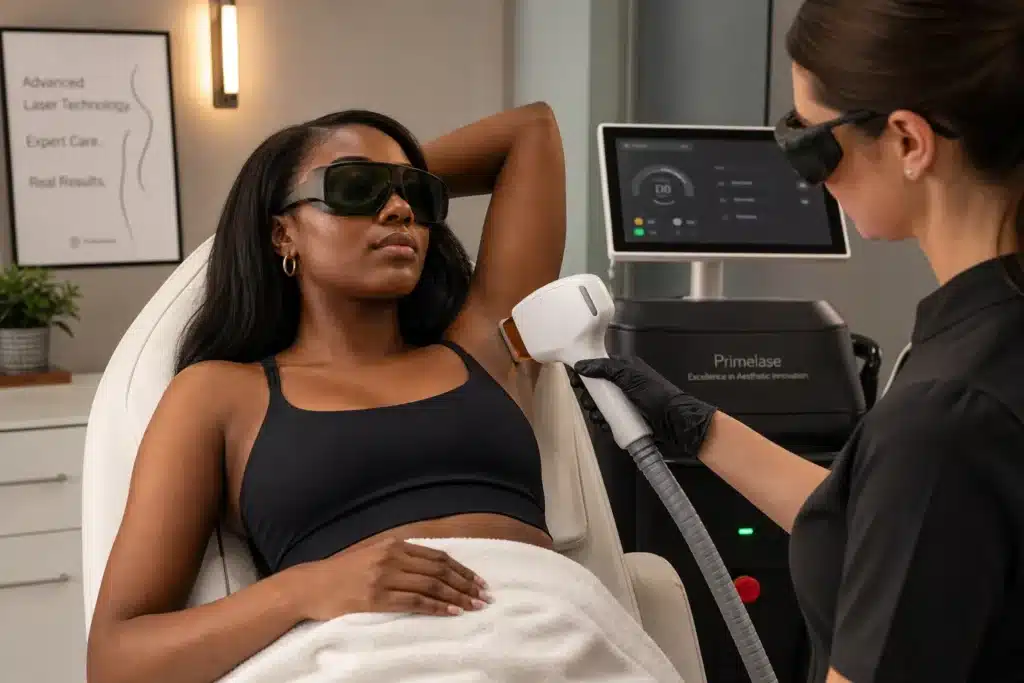
The technology has moved on considerably, specifically through long-pulsed Nd:YAG lasers, multi-wavelength diode systems with blend modes, in-motion delivery, and integrated contact cooling. Today, laser hair removal for dark skin is a realistic, achievable outcome, provided the right laser is used by a practitioner who knows how to calibrate it. That distinction matters enormously. At Lazer Lounge, treating all skin tones safely sits at the heart of our practice. We use the Primelase HR Diode Laser, a system clinically cleared for all Fitzpatrick types, including the deepest complexions, built with the wavelength range and cooling technology to match. What follows is everything you need to know before booking your first consultation.
Why darker skin makes laser targeting more complicated
Laser hair removal works by directing concentrated light energy at the melanin pigment in the hair follicle. The heat generated destroys the follicle and interrupts the regrowth cycle. The complication with darker skin is straightforward: the epidermis also contains high concentrations of melanin. When a laser cannot distinguish between the pigment in the hair and the pigment in the surrounding skin, it deposits energy in both places. That is when burns, pigment changes, and inconsistent results occur.
The Fitzpatrick scale and why it changes everything
Clinicians use the Fitzpatrick scale for laser treatments, a six-point classification system, to assess how much melanin a patient’s skin contains and how it responds to UV exposure. Types I and II describe very fair skin that burns easily. Types IV, V, and VI describe medium-brown to deep-brown and black skin tones, with significantly higher epidermal melanin concentrations. These skin types do not simply require adjusted settings on the same laser; they require a fundamentally different clinical protocol, including different device selection, lower energy delivery, extended pulse widths, and adequate cooling at every stage.
What happens when the wrong laser is used
Shorter-wavelength lasers, particularly the Alexandrite at 755 nm, are highly absorbed by surface melanin. Rather than penetrating to the follicle, they deposit energy in the epidermis first, causing superficial thermal injury. In melanin-rich skin, this thermal damage triggers the skin’s inflammatory response, activating melanocytes, the cells responsible for pigment production. The result is post-inflammatory hyperpigmentation (PIH): localised darkening of the skin that can persist for weeks to months. In more severe cases, blistering and scarring are possible. This is not a minor side effect risk. It is the direct consequence of using a device not designed for the skin in front of it.
Laser hair removal for dark skin: which devices are actually safe
Not all laser devices carry equal risk, and the differences between them are not subtle. Wavelength, pulse duration, and cooling technology are what separate genuinely safe treatment from a harmful one. Getting clarity on these differences before booking is the single most clinically relevant step you can take, and if you want a deeper read on the technological advances that drive safer outcomes, see our piece on Advancements in Laser Hair Removal Treatment.
Nd:YAG: the clinical gold standard for Fitzpatrick IV, VI
The long-pulsed Nd:YAG laser hair removal in Fitzpatrick skin types IV to VI, operating at 1064 nm, is the most widely recommended device for darker skin tones across Fitzpatrick types IV to VI. Its longer wavelength penetrates deeper into the dermis, bypassing surface melanin and targeting the follicle directly. Clinical data show that PIH incidence with Nd:YAG sits at 2 to 3%, compared with up to 19% with shorter-wavelength devices. It achieves a mean hair reduction of approximately 54% after three sessions, rising to 70 to 95% over a full course of 6 to 10 treatments. The trade-off is that it is slightly less efficient per session than diode on some skin types, which is why session count and spacing are factored into the treatment plan from the outset.
Advanced diode systems built for all skin tones
Modern diode lasers operating at 800 to 810 nm can also be safe and effective for types IV to VI, but only when they incorporate aggressive epidermal cooling, lower fluence delivery, and extended pulse widths. The Primelase HR Diode Laser used at Lazer Lounge operates across a wavelength range of 755 nm to 1060 nm, with a dedicated 1060 nm mode and a combined blend mode specifically indicated for darker skin types and tanned skin. The system is cleared for all Fitzpatrick types and features integrated contact cooling to protect the epidermis throughout treatment. Practical clinical approaches to overcome poor responses and the challenges of laser hair removal in dark skin underpin how these multi-wavelength systems are used safely in practice.
Why IPL is the wrong choice for laser hair removal on dark skin
IPL is not a laser. It emits a broad, scattered spectrum of light across multiple wavelengths simultaneously, which makes precise follicle targeting almost impossible on melanin-rich skin. Because the light energy cannot distinguish between hair pigment and skin pigment, a significant proportion is absorbed by the epidermis, dramatically increasing the risk of burns and PIH. Peer-reviewed summaries and clinical overviews for darker phototypes support this: see guidance on laser hair removal for skin types 4, 6. IPL delivers 45 to 70% hair reduction at best, with a considerably higher adverse event profile in darker complexions than Nd:YAG or advanced diode systems. Some consumer-grade IPL devices explicitly state they are not suitable for Fitzpatrick type VI. Any clinic recommending IPL for darker skin without a thorough, technically specific explanation warrants careful scrutiny before you proceed.
Realistic results for laser hair removal on dark skin: sessions, timelines, and honest expectations
Darker skin types can achieve significant, long-term hair reduction. The results are real, but they require a longer treatment course than lighter skin, and they depend heavily on the technology and protocols the clinic uses. Going in with accurate expectations protects you from both disappointment and from clinics overpromising outcomes.
Clinical evidence shows that Nd:YAG and advanced diode lasers achieve roughly 47 to 60% hair reduction after three sessions, with a full course of 6 to 10 treatments delivering 70 to 95% permanent reduction. Sessions are spaced 4 to 6 weeks apart to target hair in the active growth (anagen) phase. Hair that regrows between sessions becomes progressively finer and lighter, so the cumulative improvement is visible well before the final session.
Several practical variables affect how well treatment works beyond laser choice. Hormonal conditions such as PCOS can drive persistent regrowth even with excellent treatment, particularly in areas like the chin and jaw. Coarse, dark hair responds better than fine hair, regardless of skin tone. Consistent, daily sun protection with SPF 30+, ideally SPF 50+ mineral sunscreen, is not optional for darker complexions; UV exposure between treatments elevates melanin in the skin, increasing PIH risk significantly. Most clients benefit from one or two maintenance sessions per year after the initial course to address any minimal regrowth, especially in hormonally active areas.
Hyperpigmentation: what you need to know
PIH is the most common concern raised by darker-skinned clients, and it deserves a clear, thorough answer rather than a quick reassurance. With the right laser and the right protocols, PIH incidence is low. With the wrong approach, it is considerably higher.
What causes PIH and how common is it
PIH is a temporary darkening of the skin caused by inflammation. When heat deposits in the epidermis rather than reaching the follicle, the resulting inflammation activates melanocytes, producing localised pigment. With appropriate lasers and protocols, the incidence is 2 to 3%. With inappropriate devices, it rises to as high as 19%. PIH typically resolves within weeks to a few months, but prevention is always preferable. The fact that it is temporary does not make it something to dismiss, particularly for clients who have dealt with uneven skin tone as an ongoing concern.
Pre-treatment and aftercare that make a genuine difference
Preparation is straightforward but essential. Avoid sun exposure and tanning for at least two weeks before treatment. Stop retinoids and chemical exfoliants beforehand. Shave the area 24 to 48 hours in advance but never wax, as waxing removes the follicle the laser needs to target. After treatment, continue strict sun avoidance, apply a broad-spectrum SPF 30+ (ideally SPF 50+ mineral-based) daily, and follow the aftercare plan your clinic provides. For higher Fitzpatrick types, some clinicians recommend priming the skin with hydroquinone (available on prescription in the UK) or tretinoin before treatment to reduce PIH risk. It is worth raising during your consultation, as not every clinic volunteers this information unprompted.
Questions to ask your clinic before you commit
The questions below are not a confrontational checklist. They are a straightforward way to gauge whether a clinic has the experience, equipment, and protocols your skin actually requires.
Device, settings, and experience with skin of colour
Ask exactly which laser will be used and confirm the wavelength. An Nd:YAG at 1064 nm or an advanced diode system with a dedicated long-wavelength mode are what you are looking for. Ask whether settings are adjusted specifically for your Fitzpatrick type. Lower fluence, extended pulse widths, and integrated cooling are essential for darker complexions, not optional extras. Ask how many clients with your skin tone the practitioner has treated, and whether they can show before-and-after photographs. A practitioner who has never encountered a complication may simply lack sufficient experience rather than exceptional skill.
Patch tests, cooling, and the aftercare plan
A reputable clinic will always carry out a patch test before a full course of treatment, ideally two weeks prior to allow time to observe any PIH response. Ask specifically what cooling method the device uses, and whether the practitioner checks your comfort level throughout the session. Pain during treatment can indicate overheating at the surface, which is clinically significant in darker skin. Request a written aftercare plan and ask whether pre-treatment priming agents are recommended for your skin type. At Lazer Lounge, we offer a free consultation to go through all of this before any treatment begins, because informed clients get better outcomes. If you’d like to learn more about the full range of Lazer Lounge laser treatments we provide across the UK, our consultations cover device selection and expected outcomes in detail.
Making your decision with confidence
Laser hair removal for dark skin is not a compromise or a workaround. With the right technology and a practitioner who understands the specific protocols involved, it is a clinically effective route to long-term hair reduction for Fitzpatrick types IV, V, and VI. The technology and the person operating it are what separate excellent results from avoidable complications.
Go into your consultation armed with the questions in this guide. Treat the patch test as an essential clinical step, not a formality to rush past, it gives you two weeks of useful data about how your skin responds before committing to a full course. For anyone exploring options across Derbyshire and Nottinghamshire, Lazer Lounge offers the Primelase HR system alongside a free, no-pressure consultation to help you understand what is genuinely possible for your skin, see our Derby Laser Treatment, The Complete Guide to Advanced Skin for local information.
Book your free consultation at Lazer Lounge and bring your questions. That is precisely what it is there for.
Book your free consultation at Lazer Lounge and bring your questions. That is precisely what it is there for.





